
Chris Denesha never imagined for himself a life in the American South; certainly not a life in the American South making obscure wines.
But that’s exactly where he’s found himself, far away from his early years growing up in the Central Valley of California, and far away from his time working vineyards in and around Sonoma County. These days, you’ll find him in in the heart of North Carolina, in Asheville, where he runs his co-founded Plēb Urban Winery. It’s a place that specializes in making wines from some 20 different varieties of non-vitis vinifera grapes, including Concord, Niagra, Catawba, Cayuga white, Muscadines, and Seyval blanc, among others.
Denesha was still working harvest in the last week of October when I caught him by phone from the cab of a truck.
“I just picked up a bunch of grapes and am now headed back to the winery,” he said, engine rumbling in the background. “We pressed eight tons yesterday, and we were at the winery until 10pm last night. Harvest is still flowing for us here in North Carolina.”
In ways that are perhaps not immediately obvious, Denesha’s journey from California to North Carolina — at least as a winemaker — has been in its own way something of an oenological homecoming. For people who choose to work with native grapes, it’s important to remember that there’s a rich history to winemaking in the eastern US.
Catawba, in particular, was a very popular grape variety for eastern US winemakers. It’s a cross between vitis lambrusca and vitis vinifera, and between 1825 and 1850 it was the most widely planted grape in the United States. It was often used to make a sparkling wine that found success domestically and in Europe — including in France. The impact of downy mildew, the American Civil War, and then Prohibition decimated the market for it.
But that has not stopped Denesha and others from picking up the mantle. Indeed, there’s a small-but-growing subculture within wine — in America it is mostly in eastern and midwestern states — that’s building energy and activism around the use of non-traditional grapes. Not only that, the fire they bring to the space is unique, and their singularity is playing an important role in the effort to popularize wines made from non-vinifera wines. Their position is firm: Not all good American wine is made in California, nor is it necessarily sourced from the so-called noble grapes.
“I feel as though I’m fighting for our ability to grow grapes in a better way.”
That distinct quality among these non-traditional American winemakers? Denesha has it in spades. He exudes a fiery quality that sets him apart from some of his more staid European counterparts.
“There’s a commodification here that I started in, and I didn’t know any better until I got out of it,” he said. “I didn’t know about hybrid grapes or native grapes except that they were inferior.”
This reaction to the entrenched traditional American wine industry is perhaps embodied by the very name of Plēb Urban Winery, which points to the term “plebeian,” for everyday people. In Denesha’s telling, it wasn’t until he started farming outside California that he realized the culture around wine didn’t have to be so pretentious. And he’s outspoken about it.
“A lot of it is cultural,” he added. “Let’s be real, you’re talking to an Appalachian grape grower working with obscure varieties in small batches. When I do talk to folks, it is about fighting against the big machine. I feel as though I’m fighting for our ability to grow grapes in a better way.”
It’s a distinct energy that isn’t as detectable when chatting about making non-vinifera wines with some European producers. Franz Strohmeier, in Austria, and Thomas Niedermayr, in northern Italy, for instance, are not reacting so viscerally to a bigger machine.
And perhaps that makes sense.
Julianny Gómez, a New York-based sommelier and the executive director of PreShift NYC, makes sense of it through the lens of real estate.
“For the most part — but not always — a lot of these European winemakers have been handing down their land and wineries for generations,” Gómez said. “With each generation, each winemaker will make innovations — but they don’t have to struggle so much when it comes to getting the land or marketing their wine.”
In the United States, especially among young winemakers looking to get into making wines with non-vinifera varieties, the situation is often very different.
“A lot of these winemakers don’t necessarily own their land,” they said. “So if you’re trying to get into this space you need to be a hustler, which is where this energy is coming from.”
Many producers are working on leased land, or are purchasing their grapes from a third party, or are working other jobs to support themselves. It requires a specific personality and fortitude to wear all those hats and make the dream work, they said.
At Plēb, Denesha works with three other growers to produce a range of interesting wines. A few days after we spoke by phone, I had the opportunity to meet him and taste several in person in a hip wine bar, Lise & Vito, in Brooklyn.
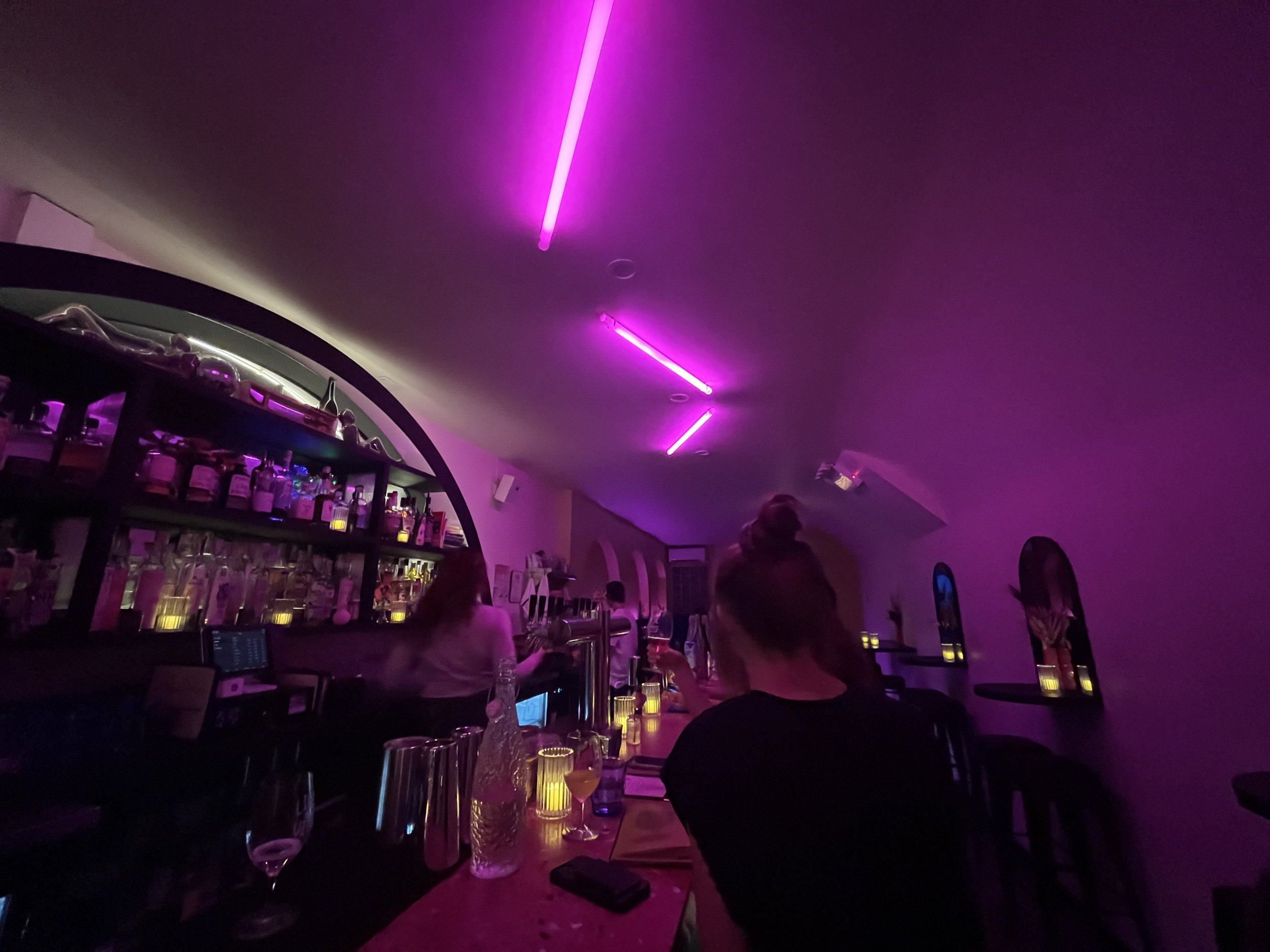
“Chris is the real deal,” said Jahdé Marley, the Brooklyn-based founder of ABV Ferments (ABV standing for ‘Anything But Vinifera). The organization has been an important community-building tool, bringing to one place a wide array of people all doing interesting work with non-vinifera grapes. Gómez is among them, and even wrote something of a love letter to ABV Ferments in the recent eighth issue of The Wine Zine.
Denesha, who met Marley while on a visit to Charleston, SC, has also taken to ABV Ferments. Since then, she’s brought him under her wing, including organizing his event at the Brooklyn wine bar.
“I’ve been lucky to find myself with a very diverse group of people from a lot of different backgrounds with similar ways of thinking,” Denesha said. “I feel very at home in this collective. What Jahdé is doing, it really does feel like a come-one-come-all type of thing.”
And that’s a strength, especially when considering perhaps the most preeminent reason these people are all working with non-vinifera wines in the first place, which is that these grapes may be a key to the future of wine in an era of climate change.
“We need pioneers, different thinkers, and different backgrounds,” he said. “We need to open our minds if we’re going to survive.”